

Charge Your Worth. How to Discuss Freelancer Fees With Your Clients.

Charge Your Worth. How to Discuss Freelancer Fees With Your Clients.

Have you ever panic-priced yourself? It’s my term for when someone asks you for your rates and you spout off a sad number that is way lower than what you actually want to charge. I’ve done it more than a few times, especially early in my career—in job interviews, discovery calls, and casual chats with people who were genuinely interested in paying me a good rate. Imposter syndrome would possess me right at the moment I was prepared to advocate for myself, and I would sputter out something entirely different than what I had planned.

Talking about money is uncomfortable for most of us, and especially so when you’re first establishing yourself as a freelancer. It’s awkward to name a price for your own work when you’re still building confidence. And sticking to that price can be tough if you’re faced with any resistance, real or perceived.

Many of us are guilty of dropping our freelancer fees early on in order to appease clients. Sometimes you just need the money and options are slim. Sometimes an opportunity comes around that could lead to great referrals and future work, and it’s worth it to accommodate. But it’s important to recognize the difference between strategy and self-sabotage. The former moves you forward; the latter keeps you stuck in place. So before you go forth and rate-slash, try these tactics for navigating common scenarios.

Talking about money is uncomfortable for most of us.

Scenario #1: You present a price and your client pushes back.

First, a word: You do not need to negotiate. Read that again. If someone questions your price or asks for a lower rate outright, you are by no means required to work with them on it. Your rates are your rates, just like watermelons at the grocery store cost… watermelon prices. Of course, offering flexibility will help you land more clients in the long run, but it’s important to remember that you have not signed a blood oath requiring you to accommodate people just because they ask. Okay. Great.
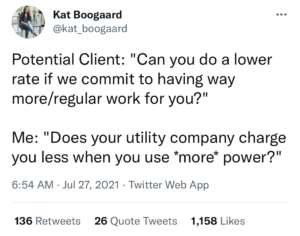
 

Tweet from Kat Boorgaard reading potential client: can you do a lower rate if we commi to having way more regular work for you. me: does your utility company charge less when you use more power?

Now, there are a couple of simple ways to navigate this conversation. First, instead of lowering your price automatically, try explaining the actual value of what you’re offering. Give them a detailed breakdown of your services, focusing on the positive impact this work will have on their business. If you’ve done similar work for other clients with KPIs you can reference, this is a great time to whip out those examples. If they don’t bite, you could instead offer to reduce the scope of the project to honor their budget, so you’re still charging what you deserve.


Scenario #2: You’re in the middle of a project and your client wants to adjust the scope and add more work.

Remember: No. Blood. Oath. Unless your contract says so, you are not required to take on additional work or shift your priorities just because your client requests it. (Hopefully, your proposal and contract explicitly laid out the work you’re doing for them, so you can refer back to it in these moments.) So if you’re not interested or able to do the work that your client is suggesting, you can absolutely push back.

But let’s say your client comes to you and they want to switch gears because their priorities have shifted or there’s more work than expected. If it sounds like a good move for both of you, then you could try offering to adjust the scope of the project for an additional cost. Remind them of the original scope and explain to them that, because the scope is increasing or changing, there will be an additional charge. You can also offer to amend the contract to document these changes so everyone is on the same page. You should absolutely make sure any conversation around changing rates or scope is documented in writing so you can refer back to it later, just in case!

Scenario #3: A project is deemed complete but the client comes back with heavy follow-up questions or requests for revisions.

This is a very common scenario, and a great opportunity to practice boundaries with clients. It’s easy to jump right in and offer unpaid help to a client, especially once the invoice has been paid. But your time is not free. So when someone requests your help, it’s important to be clear about what you can and cannot do. One simple clarifying question? Sure. But if they send you time-intensive questions or make additional requests, then it’s time to discuss pricing (again).

In this situation, let your client know that you’d love to continue working with them. Then, share your hourly rate. If you had previously charged a project fee or some other price structure, they may not realize that you offer hourly work. You can give them a time estimate if possible and offer to send over an invoice for the extra hours if they’d like to move forward with your help.

Client pushback isn’t the signal to say no or give in entirely—it’s an opportunity to find a win-win.

The Takeaway


If you leave this post with one piece of wisdom, we hope it’s this: Client pushback isn’t the signal to say no or give in entirely—it’s an opportunity to find a win-win. These scenarios may test your confidence and your communication, which is kind of awesome. Having your freelancer fees questioned and navigating tricky conversations is great practice. It helps you build those muscles, so someday soon, you can have money conversations without stress.

    Proposal or Contract: Which Do You Need?

    Proposal or Contract: Which Do You Need?

    Let’s set the scene… You’ve just finished a discovery call with a potential client. It ended on a high note—they want to move forward! You feel the thrill of a new opportunity and you want to seal the deal ASAP. So… what now? Your brain begins to spin. Do you send them a detailed follow-up or just an overview? Do you share your pricing upfront? And is an email good enough or should you attach a fancy PDF with your branding and… AHHH!

    It’s an all-too-familiar experience for freelancers. When your work requires you to self-promote—and your wallet requires you to generate income—you often feel the need to act quickly to lock in new clients. But in reality, slowing down and following best practices can set you up for greater success.


    Slowing down and following best practices can set you up for greater success.

    So… what are those best practices? Below, we’ll explain the difference between a proposal and a contract, and share tips on crafting great ones, so you can perfect your post-pitch process, land more clients, and make your day-to-day a whole lot smoother. 


    Proposal vs Contract: What’s the difference?

    A proposal—also known as a statement of work (SOW)—is a detailed breakdown of the services you’re going to offer to a client, along with your pricing. It’s essentially an extension of your sales pitch. It may include packages and optional add-ons that the client can select from. A proposal is not a legally binding document, but rather a starting point to align on exactly what you’ll deliver.

    A contract is a legally binding agreement required to officially kick off a business relationship with a client. It will generally re-iterate the statement of work, and include all the fine print that ensures you get paid (and protects you from liability), like terms and agreements around payment, confidentiality, intellectual property, and so on.

    The goal of the proposal is to reach an agreement around the scope of work

    How should proposals and contracts be used?

    After you deliver your epic pitch, the next step is to send a proposal outlining what you’re offering. This gives the client an opportunity to review the plan, ask questions, and request changes, if need be. The ultimate goal of the proposal is to reach an agreement around the scope of work, not to lay out all of your Terms and Conditions—save that for the next step.

    Once you’re on the same page and the client has accepted your proposal, it’s time to make it official. At this point, you can document all of your Ts and Cs in a formal contract, which specifies all the important stuff that you don’t want to bother with during the pitch, like who owns what, how you’ll operate as a contractor, etc. A contract requires signatures from both parties in order to proceed.

    What makes for a great proposal?

    Much like baking an Instagram-worthy sourdough, delivering a great proposal isn’t just about following the recipe—it calls for a little flair too. On top of detailing what you’re offering, you can use your proposal as another opportunity to sell your business and your services. It’s a chance to say more about who you are and what you do, share client testimonials, and give prospects a chance to really see and choose you.

    Remember, your proposal might be passed around an organization, so you want to seize every chance you get to clearly explain your offerings to other folks who might not have been included on the pitch.


    Key elements of a great proposal:

    • Statement of work, including budget, timeline, and deliverables
    • Overview of your business and the services you offer
    • Third-party validation, like customer references and quotes

    A great contract is all about the details.

    What makes for a great contract?

    A great contract is all about the details. It’s critical to dot all your Is and cross all your Ts, because you’re entering a legally binding relationship with another party. This document keeps you safe from unjustified legal action on your client’s part, but it also requires you to deliver what you promise in writing. In other words: Take it seriously! Before you share a contract with a prospective client, consider consulting an attorney or make sure you’re using a contract that has been vetted by a lawyer, like the one you can find in Harlow if you’re a user. You won’t regret it.


    Key elements of a great contract:

    • Clear payment terms and schedule of payments
    • Confidentiality, ownership of work, and IP ownership terms
    • Termination clause
    • Signature fields for both the Client and you, the Consultant

    Pro Tip: When you’re ready to up your contract game, check out this Contracts 101 podcast episode from Brittany Ratelle, an attorney for creatives. She walks you through the legal fundamentals of contracts and explains why getting everything in writing is so important for freelancers and creatives.

    Why it’s important to perfect the post-pitch process

    Once you’ve nailed down the proposal and contract process, you’ll be sailing toward more successful client relationships. These two documents lay the foundation for all the work you do. They set clear boundaries and expectations from the get-go, which helps you deliver great work, make your clients happy, and get paid on time. And we love that for you, because you deserve all the amazing things freelancing life can bring.